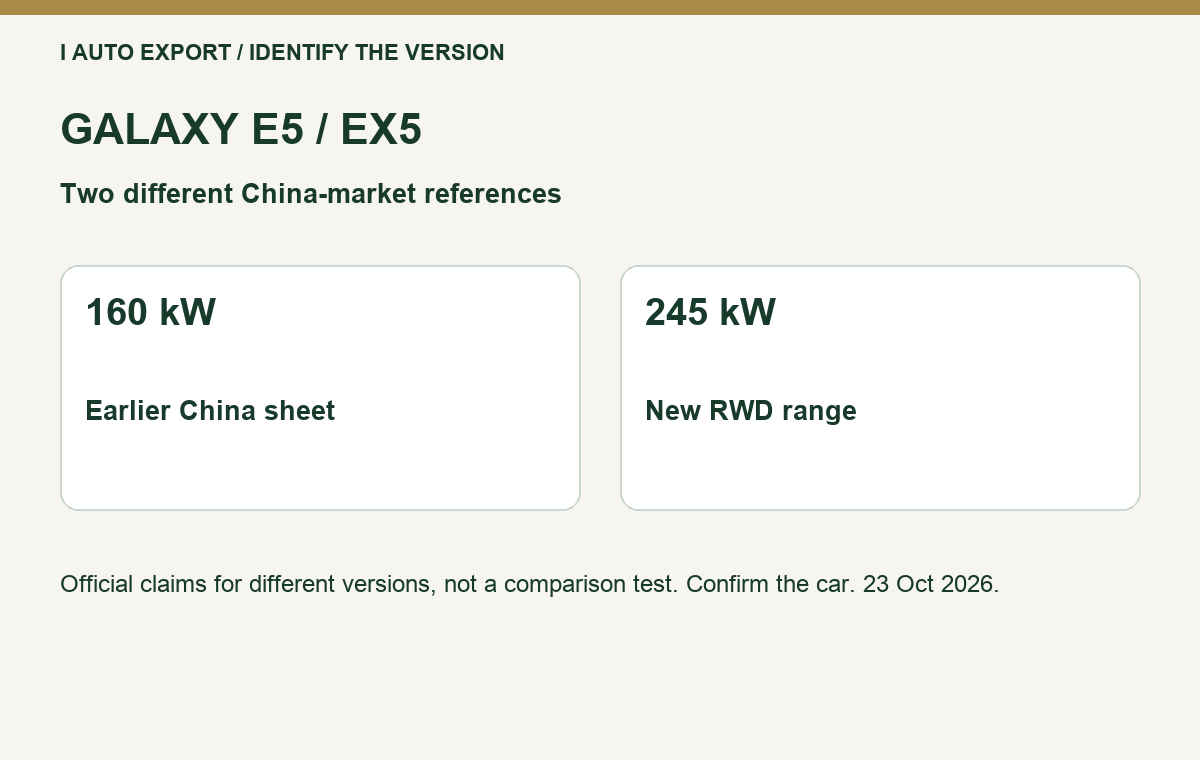
A comfortable family brief is a better starting point for the earlier Geely Galaxy E5 / EX5 than a sporty one. However, that conclusion must stay with the cars actually tested. The China website now also presents a substantially changed E5, so a familiar name no longer identifies the drivetrain or charging system.
Sources checked 23 October 2026. I Auto Export commercially sources vehicles. This is our analysis of attributed documents and driving reports, not a road test conducted by us.
Older reference or new China E5?
The published earlier official China specification sheet lists 160 kW and 49.52/60.22 kWh batteries, with 440/530 km CLTC claims. It is an earlier reference, not the specification of every car now carrying the name.
The new China E5 page advertises a new RWD/800 V/245 kW range, alongside a separate Global Classic edition. Those claims do not upgrade earlier E5s or overseas EX5s.
For a quotation, ask which family the car belongs to before comparing range or equipment. Require the production information, grade, battery and drivetrain to appear on the same offer. A year in an advertisement or a larger-looking display cannot establish the electrical architecture.
What did the earlier China-spec drive reveal?
Matt Campbell’s November 2024 CarExpert drive used a China-spec car at Ningbo International Track. He found generous rear space, but criticised heavy body movement, slow steering response near centre and intervention when accelerating out of corners. He explicitly warned that the Australian chassis tune would differ.
This helps frame the decision rather than settling it for every export. A family seeking relaxed travel may accept responses that disappoint a driver wanting sharp cornering. Try the intended car on the kinds of roads you use, with the usual passengers, instead of using a track impression as a universal verdict.
Was the Australian EX5 the same experience?
Jack Quick’s February 2025 Australian Inspire launch test praised quiet cruising and bump absorption. Frequent uneven surfaces and winding roads exposed excessive body movement; adaptive cruise also slowed too aggressively in bends. This was an early-production Australian car with a local suspension tune, not the new China RWD E5.
The two reports make comfort and body control useful demonstration priorities. Ask for a normal-road drive with the relevant wheels and suspension. Evaluate rear-passenger comfort as well as the driver’s seat, especially if your family often travels on undulating roads.
Video: the Australian Inspire in August 2025
Paul Maric’s 4 August 2025 CarExpert video covers the Australian Inspire. At 10:33–13:05, he praises quietness and bump comfort but finds soft body control. At 18:57, his cold-weather “60%” range comment is an estimate, not a measured winter result. These observations do not describe the later larger-battery EX5 or new China RWD E5. Public automatic captions contain recognition errors.
Original video; choose play to start. Screenshots remain private.
What changed in the later Australian test?
William Stopford’s August 2026 CarExpert review tested a 68.39 kWh Australian Inspire, still 160 kW/FWD. He praised cabin comfort and quietness but criticised bouncy body control and intrusive assistance; the report recorded 15.6 kWh/100 km as tested. This is not the new China RWD model or a controlled Central Asian winter result.
How far will it travel in real use?
In that Australian launch report, a low-speed average reached as low as 10.8 kWh/100 km, while uphill sections exceeded 20. Those contrasting observations do not establish one representative consumption rate or a Central Asian winter range.
Keep the testing cycle attached to any rated distance. For route planning, ask for evidence from a matching battery and software version, with temperature, speed, load and heating use. A short favourable section and a full-trip average answer different questions.
Map your regular charging stops and a fallback. Request the actual charge-port specification and an example session on suitable equipment. The charging window, battery conditions and station should be recorded together. An impressive claim on the new model’s page cannot establish the earlier car’s charging time.
Which functions will work after export?
Geely’s China fleet-sales page explicitly says some features, including intelligent driving, will not be available when exported. A domestic equipment description therefore cannot promise the same overseas functionality.
Demonstrate the functions you need in the intended destination: interface language, phone connection, navigation and relevant assistance. Write the agreed support arrangements into the offer. An announcement of a future software update is different from a function shown working on the supplied car.
Our Galaxy E5 model page uses an earlier specification reference. Send destination, year, battery, drivetrain and required functions for a version-specific offer. The Yuan Plus / Atto 3 analysis explains a similar need to separate older and newer EV versions.
Additional source references
Request a vehicle-specific quotation with the full grade, build preference and destination. Ask for inspection evidence and separate vehicle, transport and destination charges.