The BYD Qin Plus DM-i is worth investigating for everyday economy, but the smallest fuel number is a poor way to choose one. The useful question is how a documented version behaves on your route, with your charging routine. Early original tests explain both its appeal and some compromises; they do not establish the performance of every later revision.
Sources checked 23 October 2026. I Auto Export commercially sources vehicles. This is an analysis of published evidence, not our own road test. The driving evidence below concerns the original 2021 model.
Why do published fuel results differ?
Chen Haiyong’s January 2021 Autohome report described a BYD-organised economy contest: roughly 110 km, three occupants, low battery, ECO/HEV. Four cars averaged 2.6 L/100 km. The author expressly warned that competition-minded driving made this a reference result, pending a later test.
In Wang Ziping’s May 2021 Autohome test, the 120KM Flagship used 4.91 litres over 104.5 km in the depleted-battery phase, averaging 30 km/h: 4.7 L/100 km. The preceding electric phase covered 121.8 km as charge fell from 100% to 20%.
Neither number is a contradiction to solve by taking an average. They describe different procedures. The electric phase and fuel phase should remain separate in a comparison, and a petrol-only figure after starting with a charged battery cannot account for the purchased electricity. For your budget, record both energy inputs rather than treating charging as free.
What were the strengths and drawbacks on the road?
The May test’s ride and noise assessment found easy brake modulation and good low-speed refinement, but some sharp suspension reactions, limited handling agility and more obvious highway tyre noise. These observations do not establish failure rates or cover later revisions.
That makes a normal demonstration more useful than a launch sprint. Include a patched road, a speed hump and a stretch at your usual cruising speed. Bring the people who will occupy the rear seats. Ask them to compare the initial impact, the movement afterwards and conversation noise, because a comfortable first impression at low speed may not answer the long-trip question.
Which specification should you compare?
The Qatar brochure updated May 2025 separately lists 55 km and 95 km WLTP electric references, with 11.75 and 18.3 kWh batteries respectively. Those overseas rows do not identify a current China-market car. A range badge without its market, cycle and version can mislead.
Ask for the complete grade, build information and battery specification on the offered vehicle. Keep Qin Plus DM-i distinct from Qin Plus EV and Qin L. If an offer claims newer equipment, confirm it in the matching specification and photographs. A newer year in a listing does not retrospectively update the hardware of the car used in an older review.
How should you estimate ownership cost?
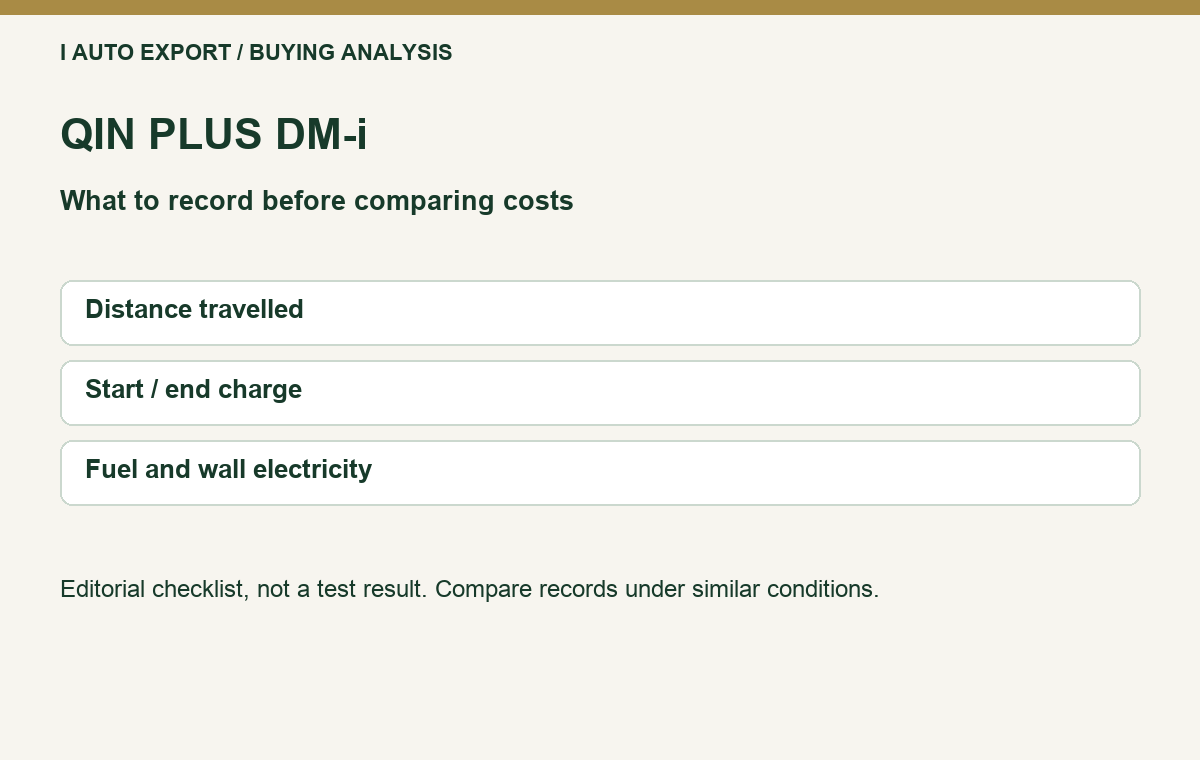
Make two route records: an ordinary charged commute and the longer journey after the initial charge has been used. For each, retain distance, beginning and ending charge, fuel added and electricity taken from the charger. Use the local prices you will actually pay. Include the charging stop in the timetable instead of comparing only a laboratory range badge.
For winter travel, request a matching-car record with temperature, heating use and speed. The sources here do not establish a Central Asian winter fuel or electric-range result. There is also no fleet-wide reliability estimate here. For a used offer, request inspection and service evidence for that particular car rather than interpreting an economical road test as proof of battery health.
Who should shortlist the Qin Plus DM-i?
A buyer who wants a sedan and can document the exact hybrid version has a useful starting point. Resolve ride comfort, charging access and support before choosing on economy alone. If you need an SUV instead, our Song Plus analysis separates its hybrid and electric references; it is not a same-route comparison.
Use the Qin Plus DM-i model page and send destination, year, grade and budget. Request the matching specification and a written description of what is included in the offer.
Request a vehicle-specific quotation with the full grade, build preference and destination. Ask for inspection evidence and separate vehicle, transport and destination charges.