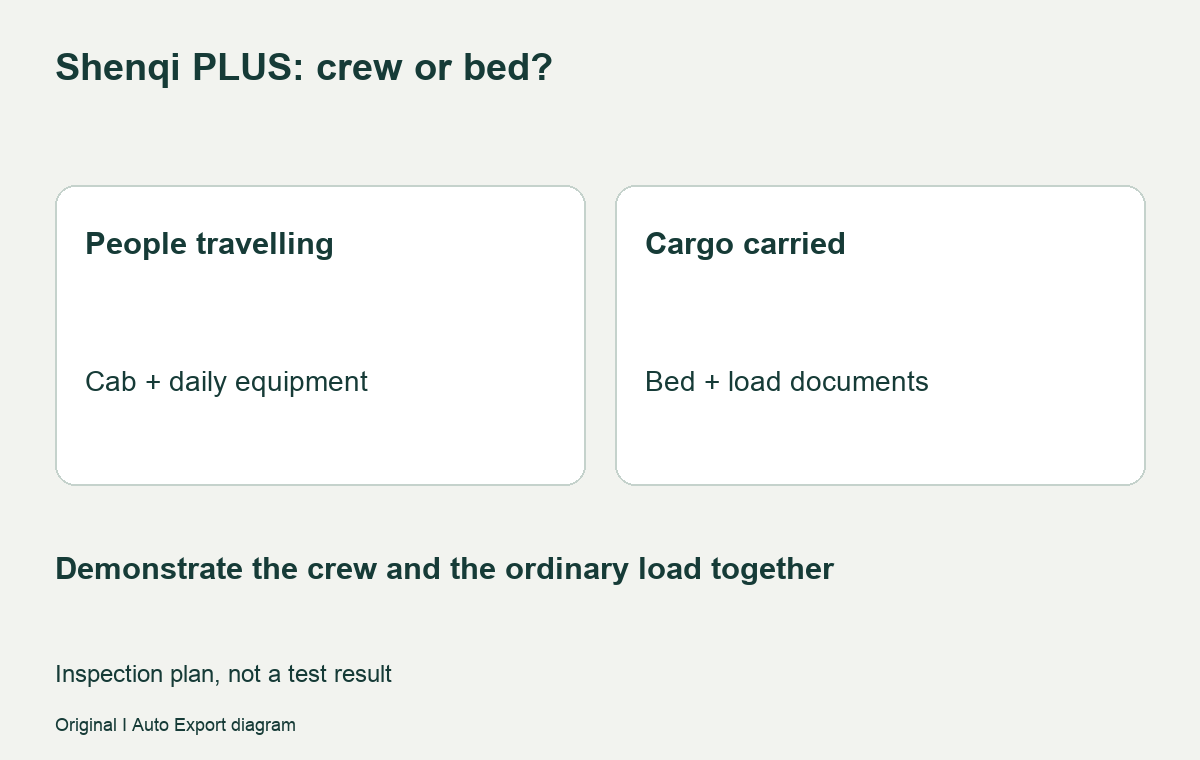
Choose the Shenqi PLUS cab around the people who must travel with the load. A longer bed does not solve a job that needs a full crew, while extra seats do not help if the ordinary consignment no longer fits. For Central Asian buyers, the useful comparison is one complete cab, bed and equipment specification against another.
Sources checked 24 October 2026. I Auto Export commercially sources vehicles. This is a Chinese-market buying analysis, not our own road, loading, winter or durability test. The offered derivative and destination requirements still need confirmation.
What changes with the cab?
Kaicene’s current Shenqi PLUS table pairs the 1.8-litre single cab with two seats, a 3,700 × 1,800 × 375 mm bed and 1,700 kg maximum rated load. The double cab has five seats, 3,010 × 1,800 × 375 mm and 1,460 kg. Both list 102 kW; air conditioning is optional in all four displayed grades.
Keep those entries together when comparing quotations. Write down whether the work needs the extra people on every trip or only occasionally. Then lay out the largest normal consignment, including the tools and securing equipment that remain aboard. Ask the supplier to reconcile that proposed use with the exact vehicle’s labels and documents.
Do not interpret the catalogue’s maximum rated-load line as an assessment of an unidentified modified truck. A fitted box, rack or other equipment should appear in the same vehicle record. Request the delivered configuration and the relevant weight documentation before agreeing a load plan. The crew, accessories and cargo need to be considered together.
What does the separate original report add?
360che’s original 3 September 2026 report describes a 1.8-litre double-cab Luxury truck with five seats and a 3.01-metre bed. It is a descriptive vehicle report without a documented loaded test or fuel-measurement protocol. Its claims about low repair costs, easy fully loaded climbing and durability are not established here.
The useful next step is a crew-and-load demonstration. Have the regular crew try the delivered cab while the ordinary tools are in their intended places. Check access to belts and daily controls. After unloading, make sure the people can still enter and leave normally. A broad statement about cabin comfort cannot replace that check for your own users.
Try the bed at the place where goods are handled. Check how each side opens, where the restraints attach and whether the intended loading equipment can approach. Include the space occupied by an open panel in the site measurement. Photograph the result with the actual containers, rather than judge a working load from an empty-bed image.
Which conveniences belong on the order?
Keep the chosen cab decision separate from the grade decision. Ask for an itemised equipment list and a demonstration of the parking aids and phone functions you expect. Confirm the cooling installation explicitly. A photograph of a screen in a Luxury vehicle does not establish the equipment in another offer, and a grade name alone does not prove which options were ordered.
For used vehicles, inspect the bed panels, cab fittings and documented condition as individual items. Ask for maintenance records and a destination parts plan using the actual engine identifier. Do not infer service life from the size of the bed or the reputation of a different commercial model. An inspection should describe this truck and the evidence available for it.
Use the Shenqi PLUS model page and request a specification with crew size, cargo, handling method and destination city. Ask for one coherent cab, bed, load-document and equipment proposal before comparing totals.