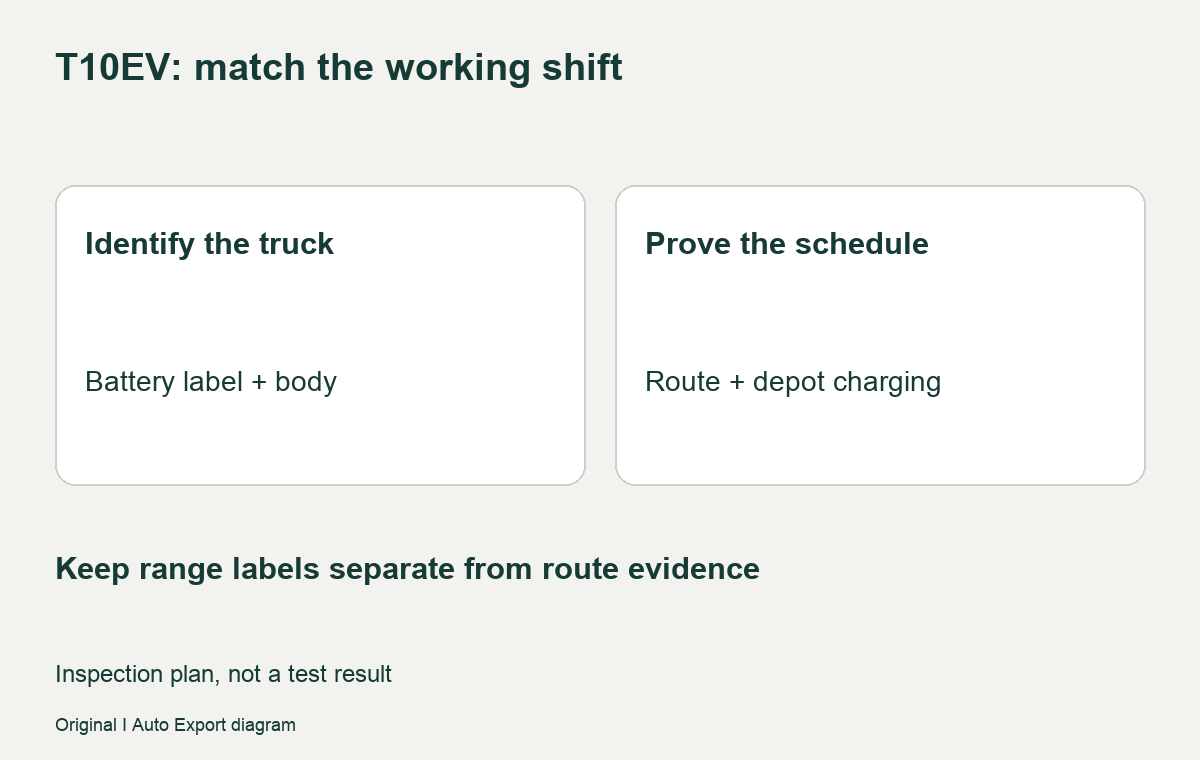
A Shenqi T10EV quotation should identify the version before anyone promises a full delivery shift. The model name has appeared on different battery and body combinations. For a Central Asian business, begin with the truck’s exact identity, the ordinary route and the time it can spend at the depot. Keep the older launch specification separate from the current catalogue.
Sources checked 24 October 2026. I Auto Export commercially sources vehicles. This is a Chinese-market buying analysis, not our own road, loading, winter or durability test. The offered derivative and destination requirements still need confirmation.
What does the current T10EV page specify?
Kaicene’s current T10EV table lists Standard/Long Range at 255/290 km NEDC, fast charging plus 6.6 kW slow charging, and battery heating. Single-cab dropside beds are 3,010 × 1,520 × 375 mm; the double-cab Long Range bed is 2,520 × 1,520 × 375 mm. The displayed table does not state battery capacity.
Ask for the offered battery’s identification and applicable manual instead of filling that missing capacity from an unrelated advertisement. Put production date, exact body and battery labels with the quotation. The same packet should identify the supplied charging equipment and its interface. A range suffix does not establish the hardware fitted to an older truck.
For a crew vehicle, try the people and tools together before selecting a cargo body. Measure the objects that must remain aboard and the largest ordinary consignment. Request the vehicle’s loading documents for the same configuration. An open bed, enclosed box and crew cab should not share a load assumption simply because they carry the T10EV name.
Why does an older battery figure need its date?
Geng Yuan’s original Autohome report of 17 April 2020 describes a 2019-named single-cab box derivative with a 35.9 kWh battery and a 200 km ministry range claim. It is launch reporting, not an independent range test. Those entries cannot identify the battery in the current Standard or Long Range offer.
This difference is a reason to inspect the labels, not evidence that the newer truck will cover your route. Obtain a route record with starting and ending charge, distance, cargo, ambient conditions and cabin heating. Include the return to base and the reserve your operation requires. State clearly whether the record comes from the offered derivative or another vehicle.
Check the most demanding ordinary working day as well as an easy round. Include the time spent waiting, loading and serving customers. A laboratory label cannot show the day’s available charging windows. Record interruptions separately so that a longer delivery time is not mistaken for a change in vehicle efficiency.
Demonstrate charging at the place where the truck will park
Confirm the usable supply and parking arrangement with the person responsible for the depot. Have suitable equipment assessed by a qualified installer. Ask the supplier to demonstrate the intended charging connection and controls. The specification’s slow-charge power does not establish the time from your arrival charge to the next departure, or guarantee the output of a particular installation.
In the trial, record the start and end charge, elapsed time and charger output. Include connection and access arrangements. For several vehicles, consider the actual shared schedule rather than assume each receives the full overnight slot. Keep a backup plan for an occupied or unavailable station, and obtain a destination service contact for the exact proposed version.
Use the T10EV model page and send a request with city, crew, body, cargo, daily distance and depot access. Ask for the battery identification and a demonstration plan before accepting an operating-range estimate.