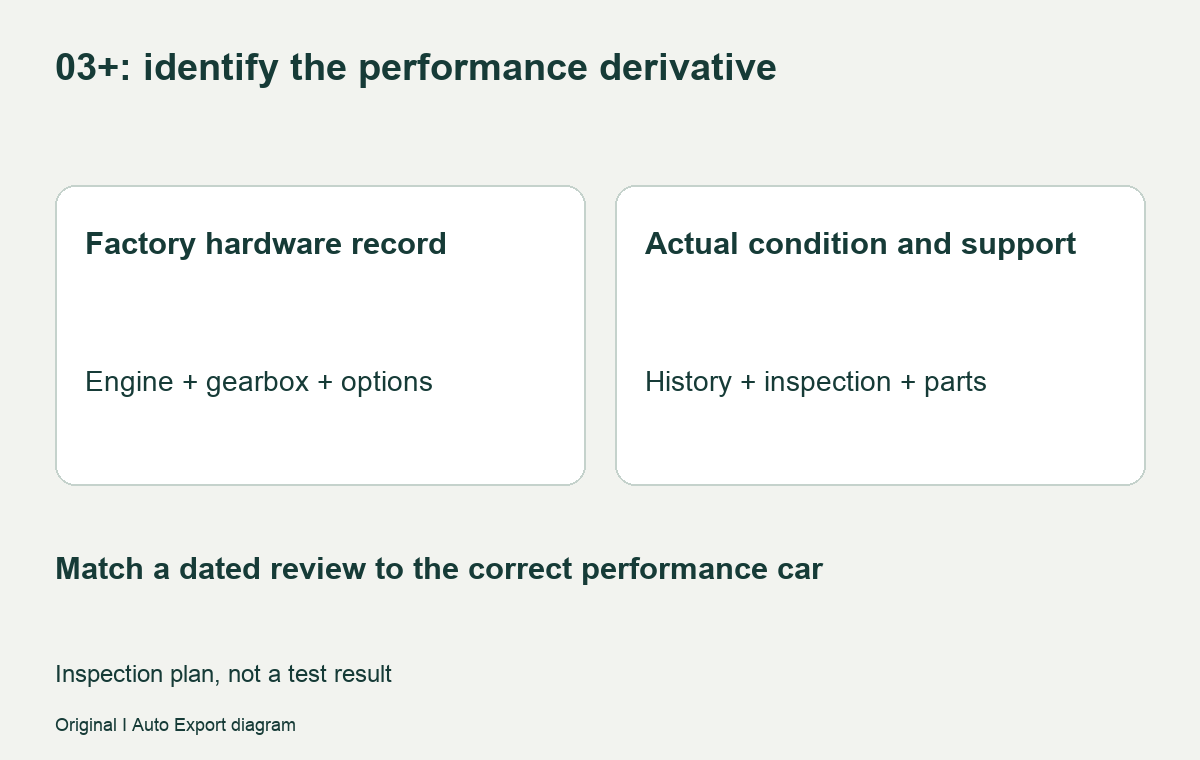
A Lynk & Co 03+ offer needs a precise derivative before an old performance review becomes relevant. Current manufacturer claims and the earliest production-car tests describe different hardware. Central Asian buyers should identify the engine, gearbox and fitted equipment, then judge whether the actual condition and daily-use compromise suit their intended roads.
Sources checked 24 October 2026. I Auto Export commercially sources vehicles. This is our buying analysis of manufacturer material and attributed original reviews, not our own test. Different production years, grades and test conditions remain separate.
Which current performance derivative is described?
Lynk & Co’s current Chinese 03+ page attaches 309 PS and 420 Nm to the Performance Advanced derivative, with a T6, 8AT and AWD. Its 5.41-second acceleration claim was manufacturer-tested at 650 m altitude and 14°C on dry, flat asphalt. These conditions and the named derivative belong with the figure; it is not our measurement of an offered car.
Request the exact factory designation and build details. Match powertrain and option records to the inspection, including braking components, suspension, wheels and tyres. A similar body kit does not establish a T6 drivetrain, and a performance badge does not prove that all original components remain fitted. Keep any modifications and the evidence for them explicit.
What does the older original review establish?
Cao Yi’s original Autohome AH100 assessment, dated May 2020, concerns the 2019-named Performance Package with 254 PS and an 8AT. He liked its coherent, supportive chassis and useful everyday compliance, but criticised steering feedback and gearbox/paddle response during hard circuit work. Those dated impressions cannot establish the performance, calibration or condition of a later T6.
A daily buyer should assess the offered car at ordinary pace with the intended occupants. Include repeated bumps, entry and the seating position used on longer trips. A favourable track-chassis impression does not settle rear-passenger comfort, and an old criticism does not prove the same calibration remains in a later production version.
For a used performance car, ask for maintenance, repairs and modification records tied to its identification. Have the fitted equipment inspected by an appropriate specialist. An attractive exterior, a claimed low distance or a review of a different car cannot establish remaining component life. Keep unknown history as a specific gap in the proposal.
Choose a workable performance-car ownership plan
Ask the destination workshop to confirm support for the actual engine, transmission, braking and suspension equipment. Request a concrete parts and service plan before comparing headline purchase prices. A generic promise to service the brand is less useful than confirmation that the fitted components can be identified and supported.
Demonstrate the parking ramp and entry clearance with the delivered configuration at a suitable location. Try daily cabin controls while parked, including language, demisting and phone connection. Record the installed software and handbook. A projected update or a foreign-market feature list does not establish what the driver can use now.
When running costs matter, request a representative fuel record with refuelling, distance, route, temperatures and load. Keep closed-course performance and normal-road consumption as separate questions. Do not treat an earlier economy-mode result as a forecast for a different derivative or winter routine. Select the identified specification, condition, comfort and support together.
Use the model page and request an offer with destination, production preference, passengers and driving needs. Ask for a complete specification and inspection of the same vehicle before comparing prices.