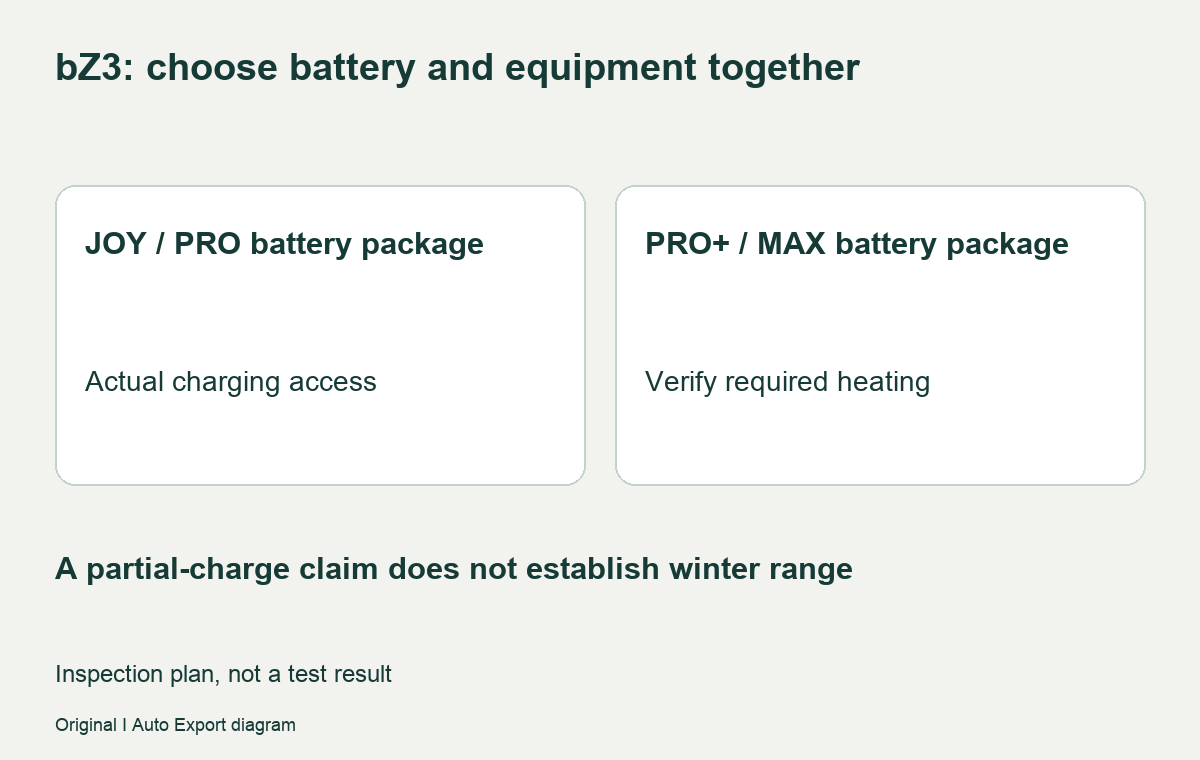
For a Toyota bZ3, choose the complete battery and equipment grade rather than the largest range number. Charging access and useful cold-weather functions belong in the same decision. Central Asian buyers should identify the current Chinese configuration, then keep an earlier circuit report separate from the performance and condition of the vehicle being offered.
Sources checked 24 October 2026. I Auto Export commercially sources vehicles. This is our buying analysis of Chinese manufacturer references and attributed original reporting, not our own road test. The current grade, older test car and offered VIN remain distinct.
Which current grades are being compared?
FAW Toyota’s current bZ3 table pairs JOY/PRO with 49.9 kWh and 70 kW maximum DC charging, versus PRO+/MAX with 65.3 kWh and 90 kW. Its 27-minute estimate is 30–80%, with temperature/station caveats. Front-seat and steering-wheel heating appear on PRO+/MAX, not JOY/PRO. These references do not establish winter range or charging speed at your station.
Ask for the exact grade and battery identification, with the fitted equipment sheet. Do not assume a larger advertised range automatically includes every comfort feature, or infer equipment from the exterior. Write down the functions the driver needs in cold conditions and request a demonstration of each on the selected vehicle while parked.
What did the older circuit report cover?
Sina Auto’s original report of 23 April 2023 describes a circuit event. It liked steering response, support and cabin quietness, but found rear-seat impacts obvious over repeated speed bumps and noted the unfamiliar window-control arrangement. It did not measure a charging curve or winter range. Its older cabin and calibration cannot establish every current Zhixiangjia grade’s behaviour or equipment.
Use those observations for an ordinary demonstration with the intended rear passengers. Record the actual tyres, pace and surfaces beside their comfort comments. Try window controls, door operation, mirror adjustment and the instrument view while parked. A distinctive control arrangement should be understood by the people using the car, not dismissed because an earlier author became familiar with it.
Make charging access concrete
Identify where the car will charge routinely, which connector and installation are applicable and how a session will be started and paid for. Have a suitable specialist confirm compatibility and installation requirements. A partial-charge estimate does not resolve an inaccessible workplace station or a household installation that has not been assessed.
For a useful charging record, request the selected car, station, starting and ending charge, elapsed time and conditions. Keep observed power over the session rather than just its highest reading. Do not compare a 30–80% claim directly with another car’s 10–80% time and call the difference a measured advantage. Ask which interval and battery condition matter on your actual route.
Try all intended passengers and luggage with seats in travel position. Obtain battery-condition and service evidence tied to the VIN, and written terms for applicable warranty and support after export. For winter-route planning, seek representative charge-use, distance, temperature, load and heating records. Keep untested assumptions explicit instead of converting a manufacturer cycle or an older circuit impression into a guaranteed result.
Use the model page and request an offer with destination, production preference, passengers and route. Ask for the full specification, inspection of the selected vehicle and written answers to unresolved questions before comparing complete purchase terms.