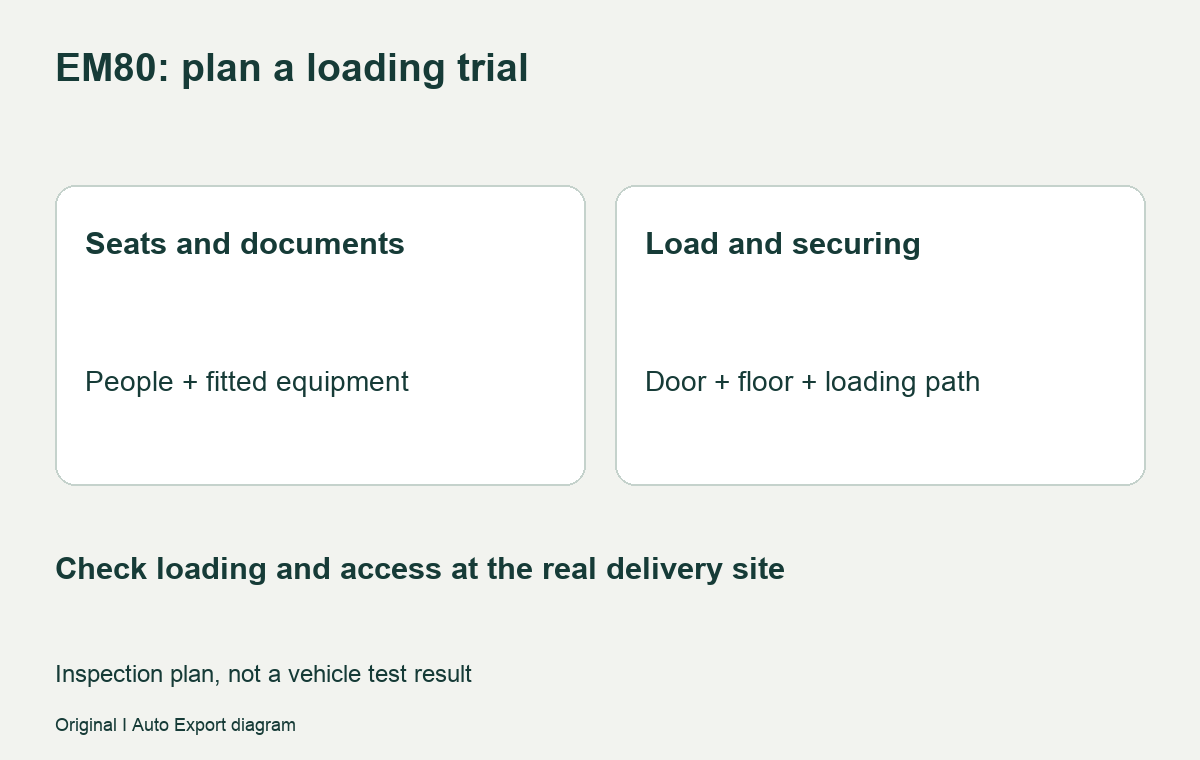
The useful EM80 cargo choice starts with seats and the load you must secure. An empty-van photograph cannot show whether your busiest ordinary delivery fits with the crew aboard. Prepare a sample load and a short record of its mass, size and handling needs before choosing a grade.
Sources checked 24 October 2026. I Auto Export commercially sources vehicles. This analysis combines the current Chinese Golden Shield table with a separately dated static firsthand inspection. We have not performed this van’s payload, braking, winter-range or durability tests.
Which loading figures belong together?
Kaicene’s Golden Shield 50 kWh table pairs two/five-seat cargo Comfort and Elite with 6/3.5 m³ and 1,210/950 kg rated load. Cargo Standard is two-seat, 6 m³, 1,210 kg. Length is 4,820/4,835 mm; width/height 1,715/1,990 mm. Cargo range is 370 km CLTC; passenger versions 380. Elite adds the reversing camera absent from cargo Standard/Comfort.
Keep each seating, volume and rated-load entry on the same line in your comparison. Do not combine the roomiest two-seat photograph with the crew capacity of another version. Obtain the exact derivative, labels and relevant documents for the offered vehicle; fitted partitions and accessories should appear in the same record. The web table is a starting point for identification.
For your sample load, list every item that stays aboard throughout the working day, then add the largest ordinary consignment. Photograph the result after securing it. Ask the supplier to reconcile the intended occupants, fitted equipment and cargo with the applicable vehicle documents. Do not treat this guide as a calculation of the remaining permissible load of an unidentified van.
What can an older firsthand inspection tell you?
李海贤’s original 14 November 2023 360che inspection concerns an earlier flat-roof, two-seat high-spec EM80. The author preferred its split rear doors for loading access and described the optional patterned aluminium floor. This was a static inspection of an older vehicle, not a Golden Shield road or loading test.
Use that observation to design a demonstration, rather than transfer its dimensions or equipment to today’s offer. Open the delivered rear doors where you normally unload. Check the space they require, the door restraints and access when parked near a wall. If your operation uses handling equipment, demonstrate the entire loading path under appropriate site supervision.
Look at the floor and securing points together. Ask what the delivered floor includes and whether an option changes the step, partition or available loading height. Try the actual containers you use. Photograph edges and fittings after the trial. A more attractive floor finish cannot establish that a bulky object will pass through the doorway.
How should you judge the extra body length?
Measure the offered van, its open-door envelope and the tightest approach at the delivery site. Keep interior load measurements separate from external access measurements. Check the whole parking manoeuvre, including the space needed to leave again. A difference on a body-length line is useful only when you compare the exact variants and the actual site.
Once the load works, assess visibility and the driver’s parking routine. Try the exact grade’s equipment, with the ordinary partition and load in position. Note any obstruction that remains during the demonstration. A camera specification does not remove the need to understand the area around the vehicle or verify the loading arrangement.
Use the EM80 model page to start a sourcing request. Include crew count, sample cargo, unloading method, site access and destination city. Request charging and destination-service confirmation for the same offered vehicle before accepting an operating-cost estimate.