The Chinese Deepal L07 deserves a version-specific comparison, especially when an economy claim attracts your attention. A current configuration, a launch drive and an earlier fuel challenge answer different questions. This guide separates them so a Central Asian buyer can match the evidence to the car being offered.
Sources checked 23 October 2026. I Auto Export commercially sources vehicles. This is attributed research, not our own road, charging, winter or durability test.
Start with the Chinese 2026 specification
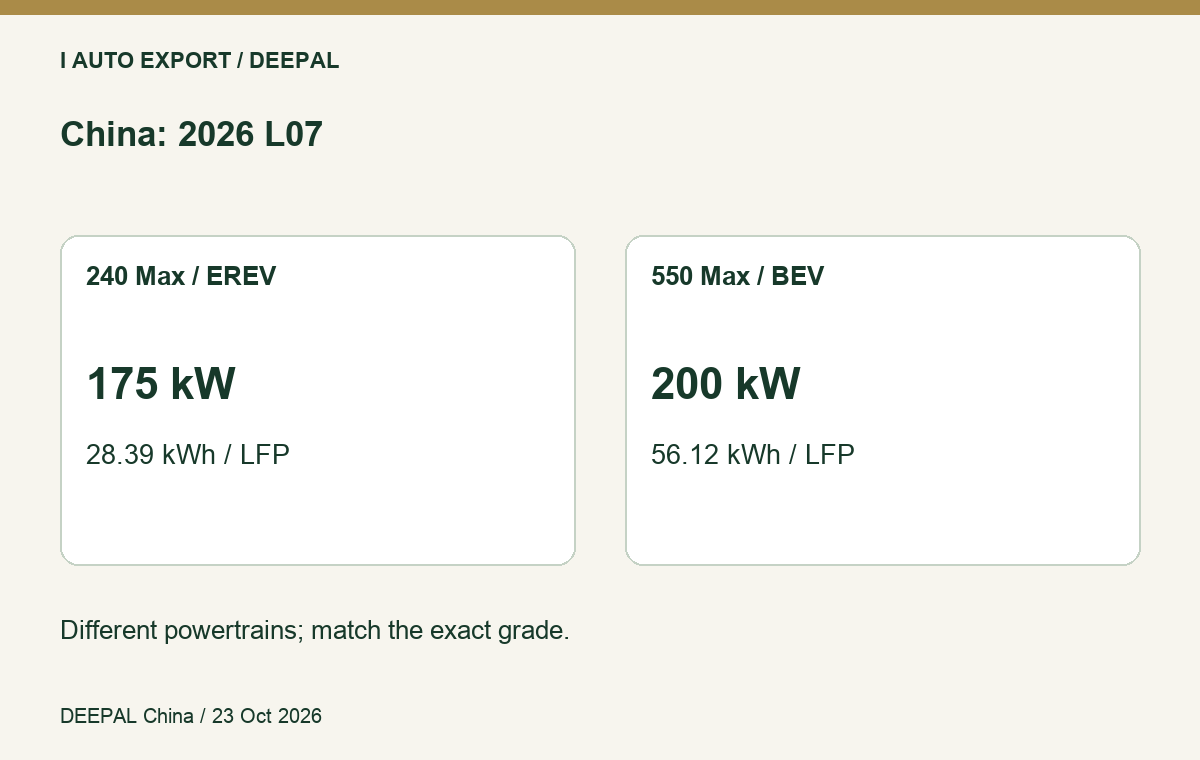
The current manufacturer table identifies 2026 L07: 240 EREV versions have 175 kW and 28.39 kWh LFP; 550 BEVs have 200 kW and 56.12 kWh LFP. Their 240/550 km labels use CLTC. The table also includes 660 BEVs; select the exact column.
Begin the enquiry with powertrain, production date, complete grade name and battery identity. Then compare the charging opportunities on your actual route. A BEV offer and an EREV offer should not share an assumed charging plan simply because their cabins look similar. For a used vehicle, keep the factory reference and the individual battery condition as separate records.
What the dated ride reviews add
China Auto Consumer Network’s 6 August 2025 launch drive described the 2026 car as comfortable and easy to drive, with improved bump absorption and restrained road noise. It was a pre-launch media drive, not a long-term ownership study; its broadly positive language should retain that limited scope.
Use that impression to arrange a practical passenger trial. Include the surfaces your family actually meets: repaired asphalt, larger undulations and the approach to a speed hump. Sit in the rear as well as the front. Record whether the passengers find the movement comfortable, rather than assuming that a flattering ride verdict settles their preferences.
In Chen Dashan’s 9 September 2024 earlier top-trim EREV drive, the chassis felt tighter and more direct. His economy challenge used 0.64 litres over 59.8 km, with air conditioning off, efficient 50–60 km/h driving and charge falling from 16% to 13%. He explicitly limited its daily relevance.
That falling charge matters: the short run used battery energy as well as fuel. It cannot establish fuel-only consumption, a repeatable daily average or a winter result. Keep the fuel receipt and both battery readings together. For your own comparison, ask for normal climate settings, a representative load and a route that includes the speed you intend to sustain.
Compare convenience on the actual car
While parked, try the everyday sequence rather than only browsing a demonstration screen. Unlock with the supplied keys, connect your intended phone, set the climate and find the controls you will use often. Record the language, software version and working functions. Ask how destination support and updates will be handled before treating a China-market feature list as your local experience.
For the road assessment, note wheel size, tyre condition, pressure and selected mode. Those details help explain why two seemingly similar offers can feel different. If assistance features influence the purchase, demonstrate their actual supported functions and limitations with an attentive driver; a media event on another road does not establish destination availability.
Is L07 a useful shortlist candidate?
It belongs on the list when its real passenger comfort, energy plan and support arrangements suit the journey. Judge the EREV against your ability to charge regularly and your longer trips; judge the BEV against charging stops and reserve needs. Neither a short challenge nor a favourable launch verdict identifies the mechanical condition of an individual used car.
On our Deepal L07 model page, send the destination, year, powertrain and full grade for a matched enquiry. Our separate S07 analysis explains another useful comparison issue: why software history and a trip that could not be reset change the meaning of an old review.
Request a vehicle-specific quotation with the full grade, build preference and destination. Ask for inspection evidence and separate vehicle, transport and destination charges.