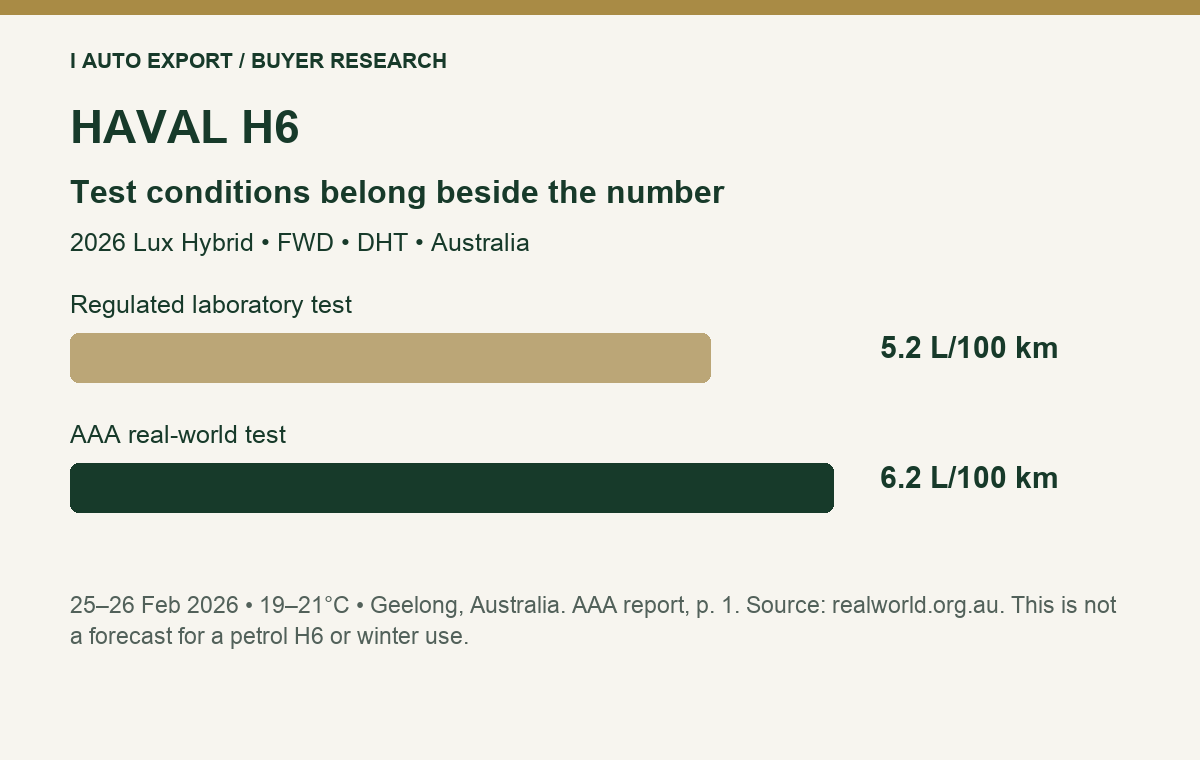
The Haval H6 stands out for rear-seat space and quiet hybrid operation in the Australian reviews below; front-seat support and screen-based controls are the main compromises to try before buying. The AAA measured 6.2 L/100 km in a Lux Hybrid FWD at 19–21°C. That result is neither a petrol-H6 forecast nor a winter-consumption promise: match the powertrain and market first.
Research updated 23 October 2026. This is I Auto Export’s source-based buyer analysis, not our own road test. We source vehicles commercially; the independent driving observations below remain attributed to their reviewers.
Which Haval H6 did the reviewers drive?
Autohome’s May 2024 cabin review identifies a China-market 1.5T two-wheel-drive Ultra. CarExpert and WhichCar tested the Australian 2025 Ultra Hybrid. The Kazakhstan petrol brochure separately lists 1.5T/7DCT and 2.0T/9DCT configurations. These are different comparison groups, not interchangeable specifications.
What the H6 does well
CarExpert praised rear-seat room and the hybrid’s quiet operation, while WhichCar also found the second row spacious. For families, this makes passenger accommodation a good reason to investigate the H6 rather than judging it only by screen size or engine output. Bring your usual passengers and child seat to a local equivalent before deciding.
The China-market Autohome review described useful storage gains after the gear selector moved to the steering column. That is a practical improvement worth checking in cabin photos: where will a phone, drinks and small bags go, and can the driver reach them comfortably?
Haval H6 disadvantages: seats, controls and driving feel
Both Australian reviews raised concerns about front-seat support. WhichCar also criticised ride comfort and the number of functions accessed through the touchscreen. These are meaningful observations about the tested hybrid; they do not establish that every petrol H6 has the same seat or suspension behaviour.
Autohome’s China-market cabin report also noted that climate adjustments relied on the screen or voice control in its test car. Ask for a short demonstration in the language you will use. A screenshot of an attractive display cannot show how quickly you can adjust the heater, demister or camera view.
Real fuel consumption: what does 6.2 L/100 km mean?
The Australian Automobile Association’s 2026 test report measured 6.2 L/100 km for a Lux Hybrid FWD with DHT, compared with its Australian laboratory figure of 5.2. Testing took place near Geelong on 25–26 February 2026 at 19–21°C. The report describes one defined test, not a fuel-use promise for every H6.
It is particularly unsuitable as a forecast for a petrol 2.0T in an Astana winter. Ask whether a consumption figure is laboratory or road-tested, which powertrain it covers, and what route, temperature and measurement method were used. A short test drive also cannot establish long-term engine or gearbox reliability.
Petrol, HEV or PHEV for Central Asia?
A petrol version is worth comparing when your priority is conventional refuelling. An HEV provides hybrid operation without external charging; a PHEV needs a separate discussion of charging access, connector, battery and depleted-battery behaviour. A foreign-market review does not confirm that the same derivative is available from China.
For Kazakhstan, Uzbekistan or Kyrgyzstan, make the decision around the actual route: urban commuting, intercity travel, winter starts, road surface and access to the right workshop. Request evidence for heater and demister operation, software language, tyre and spare-wheel specification, and the equipment on the offered trim.
Is the Haval H6 worth buying?
It is worth investigating if rear passenger space and family practicality are priorities and you are prepared to check seat comfort and control usability carefully. Compare alternatives if you strongly prefer physical controls or cannot obtain service support for the selected powertrain. We do not have a comparable long-term failure-rate dataset that would justify calling the whole H6 family either trouble-free or unreliable.
Get a quotation for the version you actually want
Use our Haval H6 model page to start a shortlist. Send the model year, engine or hybrid system, destination and budget; ask for the offered vehicle’s cabin video and written specification. The Kazakhstan powertrain guide covers the sourcing questions in more detail. A current quotation should separate the vehicle from transport and destination charges.
Timestamped Kazakhstan video reference
Timur Mustafayev’s 20 April 2026 H6 facelift review discusses a Kazakhstan-market 2.0T AWD/9DCT car. The public Russian transcript at 13:31–14:09 describes good-road comfort but a firmer response on corrugations; at 16:34–16:57 it criticises rear-door plastics and the lack of rear-backrest adjustment. Automatic captions contain recognition errors. These are attributed observations, not our measurements or confirmation of a China-market unit. Use the original video to assess context.
Additional source references
Request a vehicle-specific quotation with the full grade, build preference and destination. Ask for inspection evidence and separate vehicle, transport and destination charges.