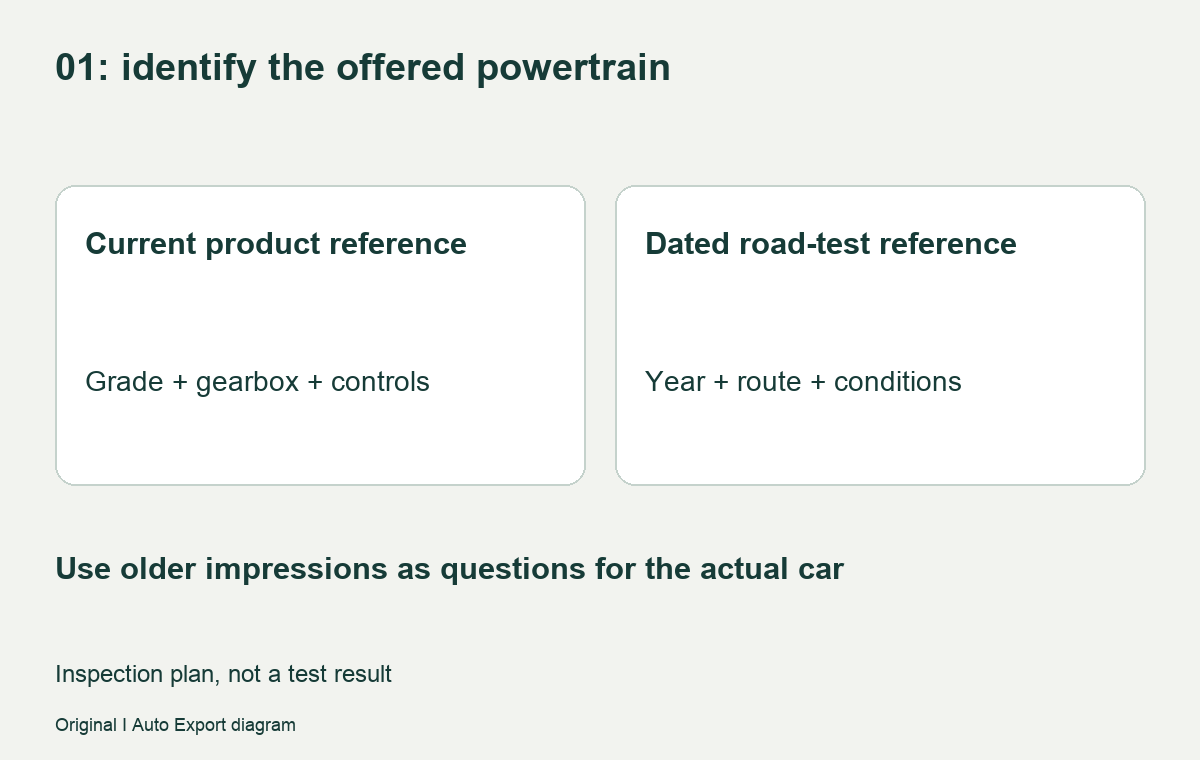
For a petrol Lynk & Co 01, identify the gearbox and production version before using a review’s comfort or fuel result. A familiar body and model number can hide a different powertrain and cabin system. Buyers in Central Asia should match the proposed car to the evidence, then assess the ordinary route with their passengers.
Sources checked 24 October 2026. I Auto Export commercially sources vehicles. This is our buying analysis of manufacturer material and attributed original reviews, not our own test. Different production years, grades and test conditions remain separate.
What does the current Chinese reference describe?
Lynk & Co’s current Chinese 01 page describes a 2.0TD T5 and 8AT, with manufacturer figures of 187 kW and 350 Nm. Its head-up-display and assistance footnotes explicitly say these features are not standard across all grades. The page is a product reference, not our road measurement or proof of the exact equipment in an offer.
Request the complete grade, build details and fitted equipment in writing. Ask for gearbox identification and an interior demonstration. Do not infer the drivetrain or assistance package from the exterior alone. If a quotation changes to another grade, keep its equipment sheet and inspection evidence together rather than carrying over assumptions from the first offer.
Which older test is being quoted?
Kong Chenxing’s original Autohome assessment of 3 April 2018 concerns a 2017-named 2.0T two-wheel-drive Yao Pro with a 6AT. He liked its responsive powertrain and steering, while criticising frequent small road vibrations and noticeable noise. Its 9.1 L/100 km mixed test targeted roughly 30 km/h average speed; it is not a current 8AT fuel result.
The older experience suggests useful questions, not a verdict that the new car must feel identical. Try the offered car over patched surfaces and repeated joints, with the actual rear passengers. Record the wheel and tyre package, road and load beside the comments. A driver’s favourable steering impression can coexist with a passenger’s concern about repeated vibrations.
Keep fuel comparisons within matched conditions. Request route distance, refuelling method, average speed, heating and temperature information. A historical mixed test is not a winter motorway forecast, and it does not establish whether a differently equipped example will meet the operating cost you have planned.
Check the cabin and support you will actually use
Set the intended driver’s seating position, then assess rear headroom, entry and luggage. Bring the ordinary bags rather than judge capacity from a wide-angle cabin photograph. Use the seat positions needed during travel. If luggage requires folding a seat, record the resulting passenger arrangement instead of comparing it with a fully occupied car.
Demonstrate phone connection, language, demisting and the controls used on each journey while parked. Ask for the installed software and relevant handbook. A feature described in a foreign-market or older review does not establish availability on the proposed Chinese car. Keep any missing demonstration as a named open question.
For a used example, request maintenance and inspection records tied to its identification. Confirm the destination workshop’s ability to support the fitted engine, gearbox and electronics. A review of another vehicle cannot establish remaining component life or applicable warranty. Choose the identified car, its condition and support together.
Use the model page and request an offer with destination, production preference, passengers and driving needs. Ask for a complete specification and inspection of the same vehicle before comparing prices.