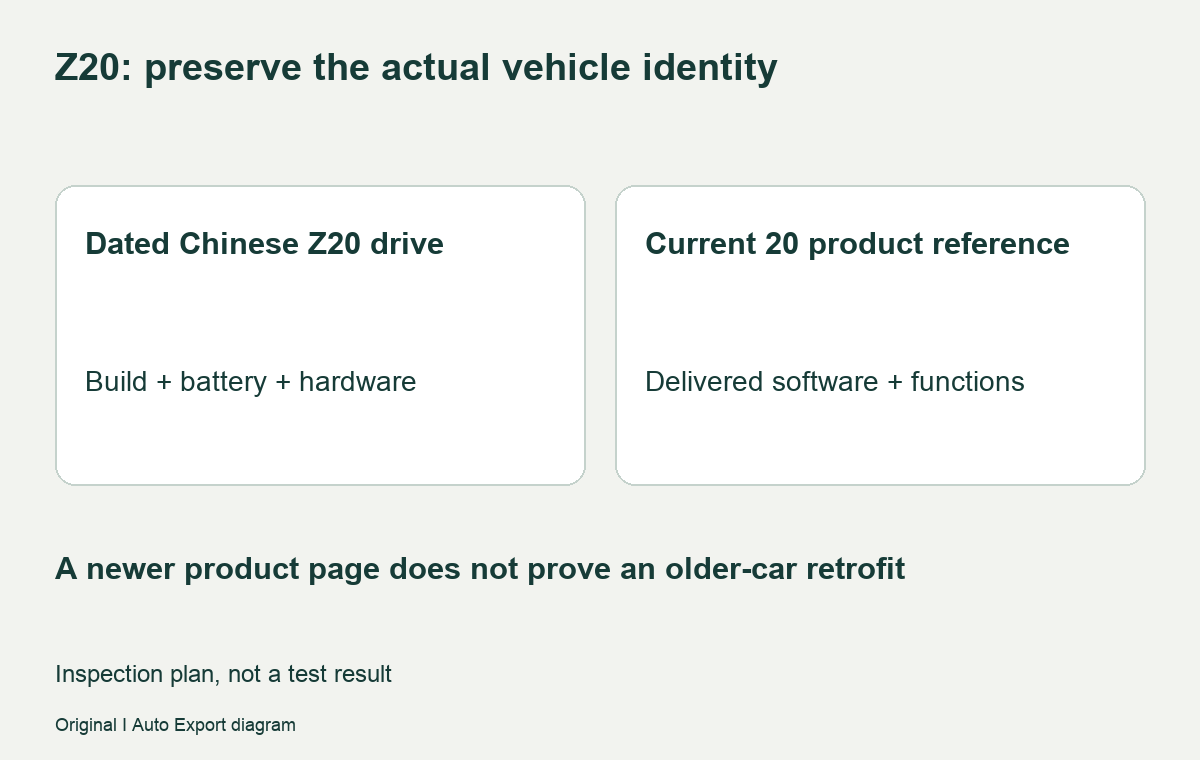
A Z20 offer needs its own specification; today’s Lynk & Co 20 page is not proof that an older car gained its new hardware. Keep the vehicle’s documented identity and installed software together. For Central Asian buyers, this distinction matters when a listing, an earlier review and a current product page appear to describe one interchangeable package.
Sources checked 24 October 2026. I Auto Export commercially sources vehicles. This is our analysis of manufacturer references and attributed original reporting, not our own road test. A static viewing, a manufacturer claim and a measured road result remain different kinds of evidence.
What did the original Z20 drive cover?
Adrian Leung’s original CarNewsChina drive of 22 February 2025 tested a Chinese Z20 on Panyu urban roads, describing a 250 kW rear motor and 62 kWh battery. He liked the balance of bump absorption and agility but found assistance less capable in sharper curves and complex conditions. The article’s charging and CLTC figures are not a documented charging session or a Central Asian winter test.
Use that dated assessment for questions about the offered car, not as a universal judgement of another market’s 02 or a newly equipped 20. Request the actual factory designation, build date, battery, motor and assistance hardware. Keep registration and inspection evidence with the quotation. A shared silhouette does not establish identical software, connected services or destination equipment.
What does the current 20 reference change?
Lynk & Co’s current Chinese 20 page advertises 800V hardware, a 12-minute 10–80% manufacturer charging claim, LiDAR and Flyme Auto 2.5 with CarPlay. Its footnote says some functions, including D2D and reversing trace, are expected progressively in Q1 2027. This page neither confirms those future functions today nor establishes a retrofit to an older Z20.
Ask which specific functions are installed and working on the proposed VIN. Demonstrate the intended phone, calling, navigation and climate controls while parked. Record a compatibility limitation or future update separately from a completed demonstration. Do not treat a current product’s feature list as an undertaking that an older car will receive the same capability through software.
Verify the practical electric-car proposal
For charging, identify the vehicle, connector, installation, starting and ending charge and elapsed time. Request observed power across the session and the relevant conditions. A later hardware claim cannot establish an earlier battery’s charging curve. Confirm home or workplace access with a suitable specialist and check the stations the driver can actually use, including activation and payment.
Try the rear occupants and ordinary luggage with seats in travel position. Check entry, the parking approach and visibility on the actual car. Assess ride with its fitted wheels and tyres recorded. An earlier reviewer’s favourable chassis impression can help frame that assessment but cannot inspect a used vehicle or determine how every passenger will feel.
Ask for condition, service history and battery evidence tied to the selected vehicle. Obtain written terms for support and applicable warranty after export. For winter-route planning, request representative distance, temperature, load, heating and charge-use records. Keep missing evidence explicit, and compare a precise Z20 offer with a precise alternative rather than construct one car from several generations’ strongest claims.
Use the model page and request an offer with destination, production preference, passengers and usual journeys. Ask for one proposal containing the complete specification, inspection of the selected vehicle and written answers to unresolved questions before agreeing purchase terms.