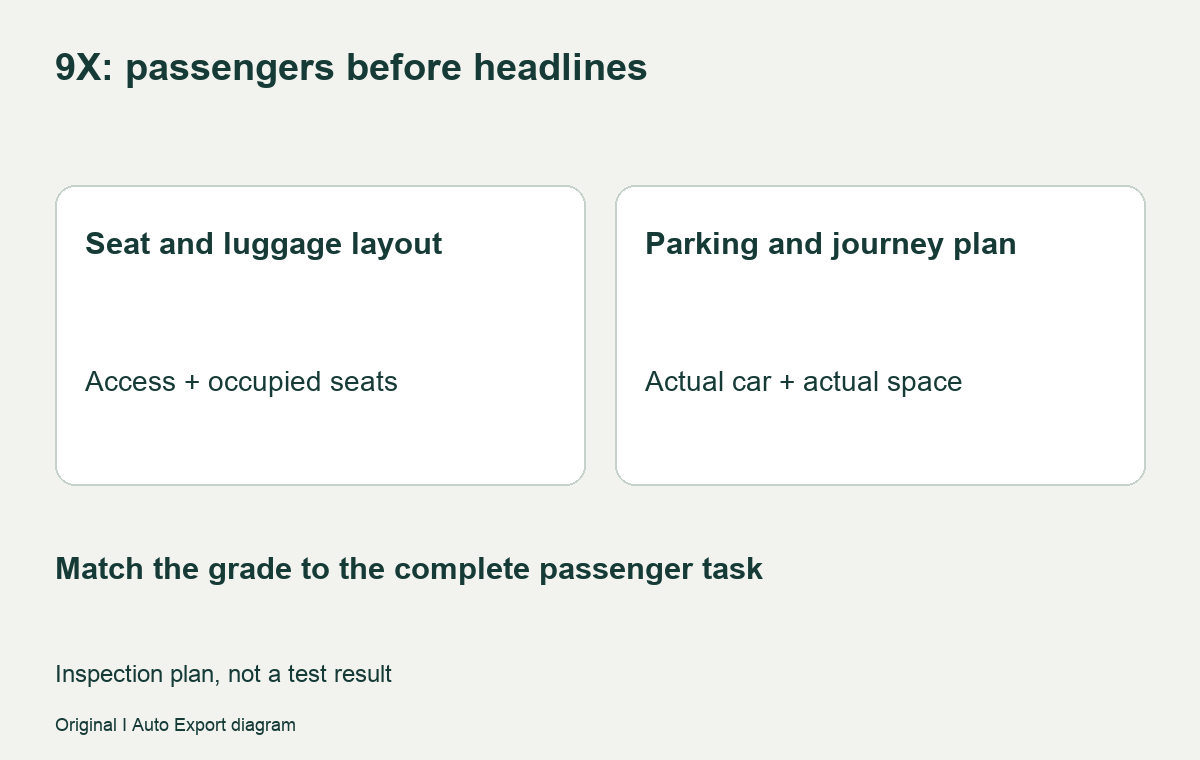
The Zeekr 9X makes most sense when the passenger arrangement works before the performance figure is considered. Buyers choosing a large luxury SUV need to inspect access, luggage and parking with their own occupants. A short launch drive offers an initial impression, while the exact grade and market determine which equipment is actually in the offer.
Sources checked 24 October 2026. I Auto Export commercially sources vehicles. This is our analysis of manufacturer material and attributed original driving reports, not our own road test. Market, grade, date and test limits remain attached to each reference.
Keep market and motor grade together
Zeekr’s UAE 9X page lists a 900V architecture and 70 kWh battery, with a dual-motor Ultra and tri-motor Hyper/Obsidian. The manufacturer lists rotating second-row seats and 48V active suspension for the latter two. This is UAE-market information; it does not establish equipment or warranty on a separately sourced Chinese vehicle.
Request the factory grade and complete equipment sheet. Ask the supplier to demonstrate the actual seat functions and suspension identification. Keep a marketing photograph separate from fitted equipment evidence. A higher power figure is not a complete description of the passenger package, and a familiar grade name may not settle differences between markets.
What can the very short first drive tell you?
James Wong’s original CarExpert review of 12 May 2026 tested a Chinese Hyper on a carpark course with a ninety-metre acceleration section, braking, humps and obstacles. He liked smooth strong acceleration and the cabin ambience, but felt sharper bump impacts than expected on 22-inch wheels. He explicitly needed public-road testing; his brief cabin time also limited seat assessment.
That is an initial course impression, not proof of comfortable motorway travel. Arrange a normal-road ride in the offered car with the intended rear occupants. Include the surfaces and pace typical of your routine. Ask passengers to describe seat support and body movement rather than simply agree that the specification looks luxurious.
Check entry to every occupied row, with front and second-row seats in realistic travelling positions. Try the passage, door opening and access with the person who will use them. A display arrangement that opens an impressive amount of space may leave another passenger without the seat position needed during travel.
Test the complete passenger and luggage arrangement
Bring the ordinary cases and a written occupant list. Load them with every required seat usable, then check access to items needed at intermediate stops. Ask for the vehicle’s applicable mass and load documentation, including fitted accessories. Space for objects does not by itself establish that the completed passenger-and-luggage load is acceptable.
Measure your garage entrance and turning approach against the actual car, including mirrors and door opening space. Demonstrate a normal parking manoeuvre at a suitable location. Cameras can help the driver judge a gap; they do not enlarge the gap or confirm that another driver will be comfortable using the same space.
For regular journeys, request fuel and charge records with clear start and finish boundaries, route, temperatures and load. Check the charging interface, everyday controls and destination support. Do not infer low-charge fuel use, winter endurance or assistance behaviour from a brief launch course. Choose the grade around documented passenger use and a workable support plan.
Use the 9X model page and request a matched offer with destination, production preference, passengers, luggage and charging access. Ask for the specification and evidence of the same vehicle before comparing prices.