The Zeekr MIX deserves a demonstration of the entire door-and-seat routine, not just a photograph of its lounge arrangement. A versatile parked cabin and an easy everyday family journey are related questions, but they need different checks. For Central Asian buyers, the useful decision is whether the actual car works with their passengers, parking space and support access.
Sources checked 24 October 2026. I Auto Export commercially sources vehicles. This is our analysis of manufacturer material and attributed original driving reports, not our own road test. Market, grade, date and test limits remain attached to each reference.
What does the original manufacturer reference establish?
Zeekr’s launch announcement of 23 October 2024 describes a 4688 mm body, 3008 mm wheelbase, 1.48 m double-sliding-door entrance and front seats rotating 270 degrees. It lists 76 kWh LFP/102 kWh NMC options with 550/over-700 km CLTC claims. These dated manufacturer references are not our measurements or an identification of every later offered MIX.
Match the offered production specification before borrowing a battery or range figure. Keep the entrance claim separate from the clearance needed beside the parked car. The space through a doorway and the space needed to operate it are different measurements. Ask for the actual parking demonstration with the delivered door equipment and a realistic neighbouring obstruction.
How did the original road reviewer find it?
Kevin Williams’s InsideEVs review of 13 January 2025 describes about ninety minutes in a dealer-supplied MIX in Shanghai. He liked its comfortable, quiet cabin and compliant suspension, but found unusual proportions awkward on a parking ramp and Chinese-language seat conversion cumbersome. The published correction specifies mechanical suspension with adaptive dampers, not air suspension; this was not a winter or durability test.
Use that impression to plan a precise inspection. Ask the intended driver to assess the actual ramp, sightlines and low-speed manoeuvres at a suitable location. Do not treat a tight-turning marketing claim as proof of comfort on every narrow approach. A driver needs to judge the corners and the path used in daily parking.
Inspect the cabin in both parked and travel use
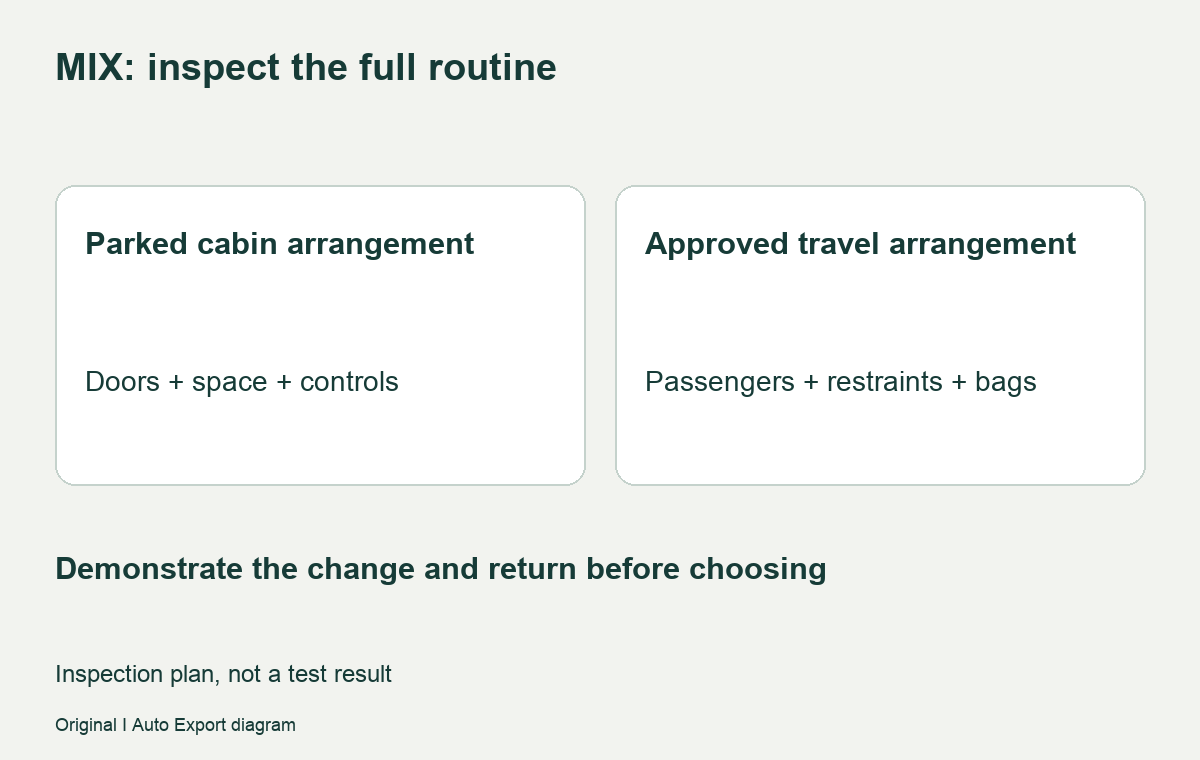
Have the supplier demonstrate the permitted seat configurations according to the exact handbook, while parked. Check language comprehension, completion indicators and the return to the approved travel position. Confirm applicable seating and restraint requirements from the vehicle documents; a lounge photograph is not approval to travel in the displayed arrangement.
Bring the ordinary passengers, child-seat requirements and bags. Assess entry, the occupied seating arrangement, belt access and luggage together. Ask a competent installer to confirm child-seat compatibility where relevant. Keep detachable tables and accessories in the inspection record, including how they are stored for travel. Attractive flexibility can still require a routine the family must learn.
Try the frequent tasks rather than only the most dramatic transformation: getting a passenger in beside a parked neighbour, reaching a bag and returning the cabin to its travelling layout. Record the car’s actual controls and delivered accessories. If a needed operation cannot be demonstrated in a language the driver understands, keep it as an unresolved purchase question.
For daily charging, identify the battery and interface and obtain a representative session record. Keep heating, route and charge boundaries with any consumption evidence. Arrange destination software and mechanical support for the same vehicle. A launch claim or short Shanghai drive cannot establish winter range, connected-service availability or the long-term operation of the doors and seats.
Use the MIX model page and request a matched offer with destination, production preference, passengers, luggage and charging access. Ask for the specification and evidence of the same vehicle before comparing prices.