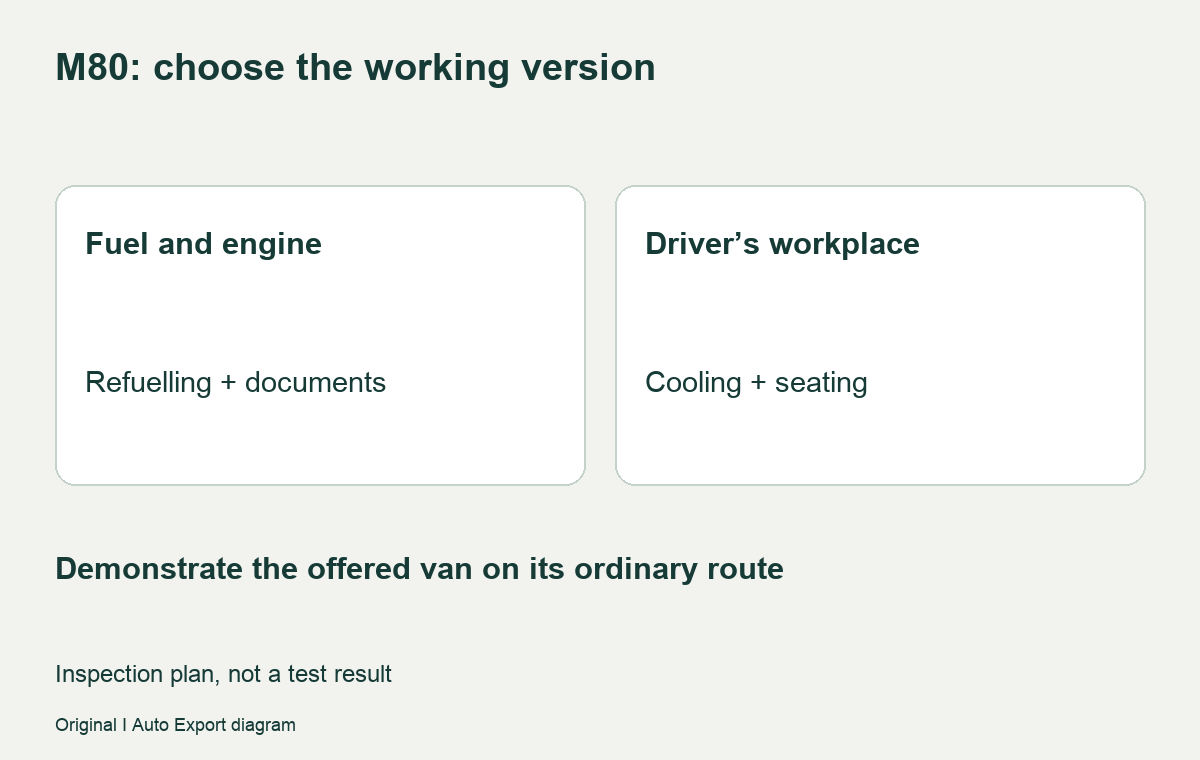
For the Changan Ruixing M80, petrol versus CNG and Basic versus Comfort change the working specification. The current Chinese table lists different engine outputs for the two fuels, with air conditioning optional on Basic and standard on Comfort. An older 1.5-litre review liked the space and easy controls but criticised low-speed pull, bumps and cooling; those concerns do not establish faults in the current 1.6-litre versions.
Sources checked 24 October 2026. I Auto Export commercially sources vehicles. This is a buying analysis of the current Chinese manufacturer table and an earlier firsthand drive; we have not performed our own fuel-consumption, loaded-climbing, winter or durability test.
Petrol and CNG are separate M80 specifications
Kaicene’s current M80 table lists 1.6-litre petrol DAM16KR at 90 kW/158 Nm and CNG DAM16KRC at 77 kW/129 Nm, both five-speed manual. Air conditioning is optional on Basic and standard on Comfort. Petrol Comfort lists two/four seats; CNG Comfort two/four/five. These are Chinese catalogue entries, not a guarantee for an unidentified offer.
Put the offered engine identifier and fuel system on the quotation. For CNG, ask for photographs of the installed cylinders, their labels and the applicable inspection documents. Have the proposed filling arrangement and service support confirmed at the destination. This guide does not establish acceptance of a particular cylinder installation or vehicle in another country.
Compare the working route before estimating fuel savings. Note where refuelling would occur, opening hours and the detour from an ordinary delivery round. Obtain a representative consumption record for the actual version and load. A cheaper unit of fuel cannot by itself show the total cost of an interrupted shift or prove the offered vehicle’s consumption.
What did the older road reviewer actually find?
PCauto’s 23 May 2014 firsthand review, by limingkai, concerned an early 1.5-litre seven-seat vehicle. The reviewer liked its space, light steering and clear manual shift, but reported weak low-speed pull, firm bump responses and disappointing air conditioning. These subjective observations do not establish how the current 1.6-litre petrol or CNG version drives.
Use the mixed verdict to plan a driver trial. Start with seat adjustment and repeated entry and exit, then try the normal parking approach. During an appropriately supervised drive, assess clutch take-up and gear selection with the intended driver. For a route involving gradients, ask for evidence under representative loading rather than infer climbing ability from an empty demonstration.
Check cabin cooling while the vehicle is stationary and during a normal run, with the intended occupants. Confirm that the quoted air-conditioning installation is actually present. Inspect the control operation and obtain any relevant service history for a used vehicle. One old review’s cooling complaint is a reason to check carefully, not proof that every M80 has the same fault.
Choose the crew layout before buying convenience equipment
Map the people, tools and consignments that travel together. Try the delivered seats and partition with the ordinary load in place. Keep the vehicle’s documents with that layout. Do not combine a seat count from one fuel/grade column with photographs of another, or assume that an old seven-seat review identifies a current cargo derivative.
For a used example, record the condition of the clutch controls, doors, floor and cabin fittings during inspection. Separate visible condition from claims about mechanical life. Ask for the maintenance record and a destination workshop’s parts plan using the exact engine code. The aim is a checkable offer and demonstration, rather than a reliability verdict based on one article.
Start at the M80 model page. In a sourcing request, include fuel preference, city, crew, normal cargo and route. Request the applicable specification, equipment list and inspection evidence for the same proposed vehicle.