The Chery Tiggo 7 Pro’s family appeal needs to be judged alongside the engine and gearbox actually offered. A roomy cabin and generous equipment do not settle how a car behaves in traffic. The evidence below helps organise that decision while keeping the China-market reference, a newer Kazakhstan model and an Australian road test separate.
Sources checked 23 October 2026. I Auto Export commercially sources vehicles. This is an analysis of identified sources, not our own road test.
Does a Tiggo 7 Pro listing mean CVT or dual-clutch?
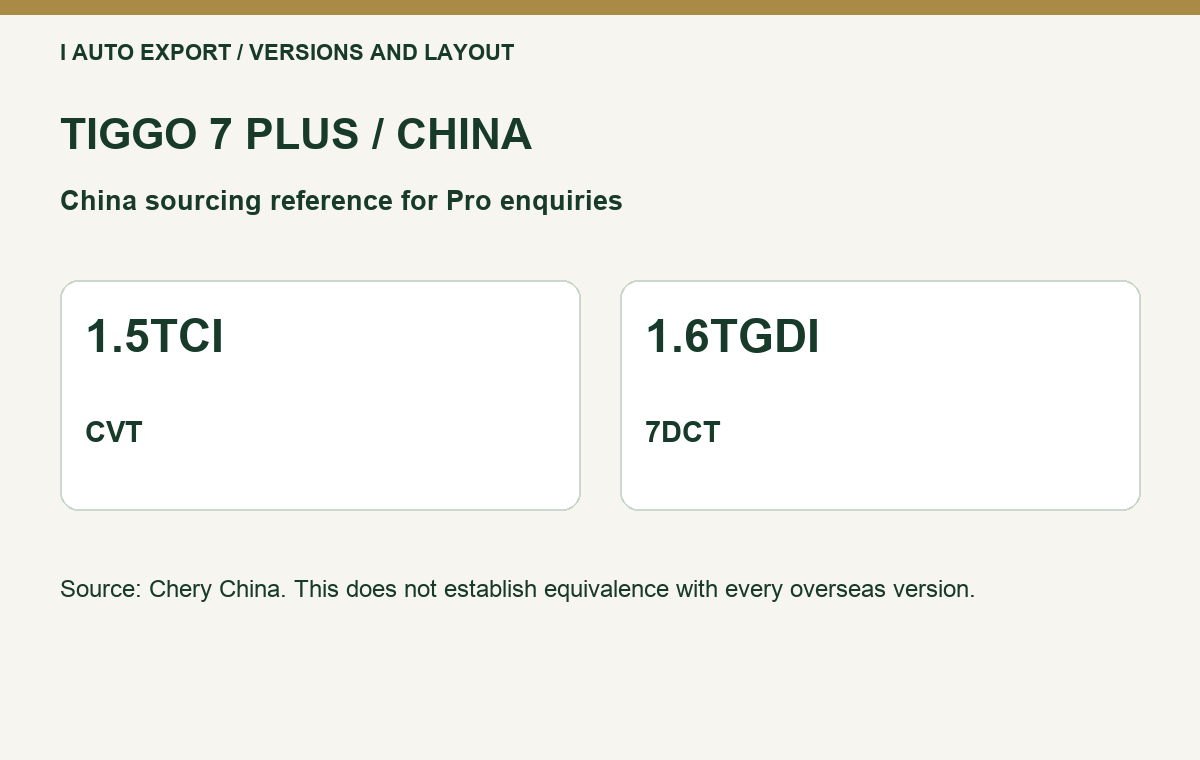
Our model selector uses the China-market Tiggo 7 PLUS as its sourcing reference. That official page lists both 1.5TCI-CVT and 1.6TGDI-7DCT grades. The naming correspondence is a buying reference, not proof that every overseas Pro or Pro Max has identical equipment.
Put the engine, transmission and full grade on the enquiry, then match them to the offered vehicle. If a road test concerns the dual-clutch version, do not treat its shift behaviour as evidence about the CVT. A shared model family is not a substitute for matching the actual powertrain.
What did the Australian road test find?
Matt Campbell’s May 2025 CarExpert test concerned an Australian SE+ 1.6-litre FWD with seven-speed DCT. He liked the comfortable, spacious cabin and reasonable ride, but criticised low-speed powertrain hesitation, tyre response and intrusive monitoring/lane assistance. His mixed-route observation was 7.8 L/100 km, not a Central Asian winter test.
For a family buyer, the useful demonstration starts before the highway. Try ordinary moving-off, a parking manoeuvre and stop-start traffic in the exact gearbox version. Notice how easy it is to request a small change in speed. Then include an uneven road and the cruising speed you normally use, so the comfort decision reflects more than a brief showroom loop.
Is the newer Kazakhstan Tiggo 7 the same reference?
The Kazakhstan sheet for 2026-built Tiggo 7 lists 1.6-litre DCT7 grades with FWD or AWD and a 110 kW output. That is a different published market/version reference. It should not silently replace the China PLUS specification or the tested Australian SE+.
Ask the supplier to identify which publication matches the offer. Photographs should agree with the claimed interior, controls and drivetrain specification. A newer badge or body update does not automatically bring the same calibration, assistance package or warranty terms as a foreign review.
How should you assess the assistance criticism?
Use it to request a demonstration of the delivered software, dashboard messages and controls. Have the seller explain the installed features and their limits using the matching handbook. Check that the interface language is usable by the regular driver. A long equipment list is less helpful if an important function is difficult for that person to understand.
The cited test reports its own car’s behaviour. It does not establish a fleet-wide defect rate or prove that every later update behaves identically. Keep the tested grade and software uncertainty attached to the criticism when comparing it with a different offer.
What should a Central Asian family check?
Bring the usual rear passengers and the luggage you carry. Check seating position, access and the boot opening rather than choosing solely from a volume figure. For a long route, request consumption evidence with speed, load and temperature; budget from a comparable record rather than the most favourable published number.
Confirm the specified fuel and service requirements for the actual car. An overseas warranty statement should not be assumed to cover a separately exported vehicle. Agree who supplies parts and handles support in the destination before comparing total offers.
Who should shortlist the Tiggo 7 Pro?
It is worth a closer look when the documented version meets your cabin and daily-driving needs. Resolve gearbox response and equipment matching before choosing on features alone. Our H6 review analysis gives another family-SUV reference, not a same-route comparison.
Use the Tiggo 7 Pro model page and send destination, year, engine, gearbox and budget. Request the exact specification with the written offer.
Request a vehicle-specific quotation with the full grade, build preference and destination. Ask for inspection evidence and separate vehicle, transport and destination charges.