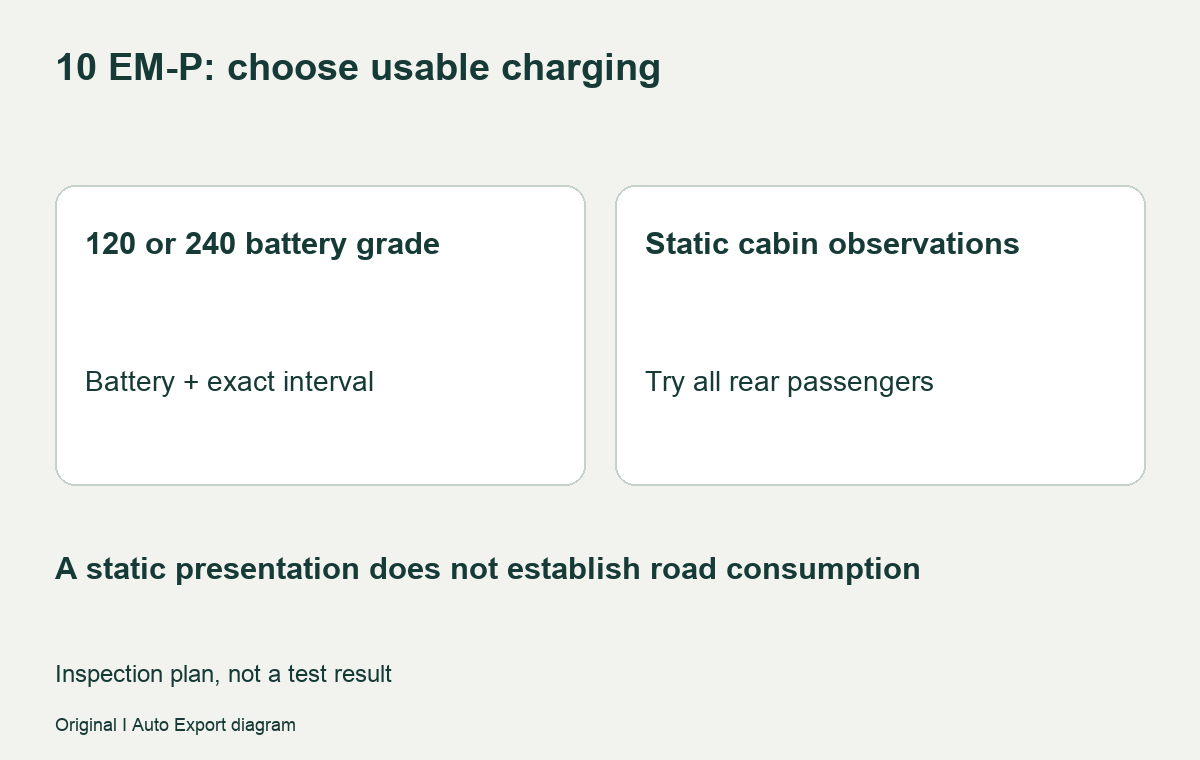
Choose a Lynk & Co 10 EM-P battery version around the charging opportunity you can actually use. A well-equipped static display cannot establish road consumption or the installed functions in a later offer. Central Asian buyers should keep the battery, assistance package and delivered software together, then request evidence that matches their normal journeys.
Sources checked 24 October 2026. I Auto Export commercially sources vehicles. This is our analysis of manufacturer references and attributed original reporting, not our own road test. A static viewing, a manufacturer claim and a measured road result remain different kinds of evidence.
Which battery belongs to the named grade?
Lynk & Co’s Chinese 10 EM-P footnotes identify 18.4 kWh CATL batteries for 120 AWD Halo/Ultra and 38.2 kWh Golden Brick batteries for 240 AWD Ultra/Sport. Its advertised under-13-minute charging interval is 10–60%, with condition caveats. This is not a 10–80% session or a winter-range measurement, and current H5/H7 equipment must be checked by grade.
Write down how often charging is available between journeys, not just the longest electric-range headline. Ask for the offered battery’s identification and an applicable specification. Compare the same starting and ending charge when assessing session times. A larger battery and a different partial-charge interval answer different questions; neither alone decides which version fits your routine.
What does the original static report establish?
Jiashipai’s original static presentation, dated 7 July 2025, described generous rear space and a broad armrest particularly suited to one or two rear occupants. It explicitly awaited dynamic behaviour and pricing. Its early charging and equipment announcements were not measured road results or proof of every later grade’s delivered specification. Treat the report as a dated cabin viewing, not a completed drive.
If three people will use the rear bench, try that exact arrangement with the armrest stowed, their usual seating positions and any necessary child restraint. Check access to buckles and everyday entry. An attractive two-person display does not answer whether your full passenger group fits. Keep any parked relaxation layout separate from the proper travel arrangement.
Confirm the functions that will arrive with the car
Request the complete assistance and cabin equipment list rather than infer the package from a LiDAR housing or an early launch description. Demonstrate language, climate, phone connection and installed software while parked. Record which features work now, which depend on compatible devices and which are described as future updates. A future promise should remain a separate condition of the offer.
Check SAMR S2026M0112V VIN applicability and completed remedy.
Obtain a dated response and any campaign-work record tied to the selected VIN. Agree where open work will be completed before shipment. Confirm ordinary service access and applicable warranty after export separately. A generic statement that the car has assistance equipment cannot resolve campaign status or destination availability.
For running costs, request a representative record with fuel, electricity, distance, starting and ending charge, temperature and climate use. The static source used here cannot settle those costs or winter range. Assess ride in the actual offered configuration and document any inspection findings. Choose the battery only after usable charging, passenger fit and support are clear.
Use the model page and request an offer with destination, production preference, passengers and usual journeys. Ask for one proposal containing the complete specification, inspection of the selected vehicle and written answers to unresolved questions before agreeing purchase terms.